Why coherent narratives support learning
initial situation
Digital learning offerings often consist of a sequence of individual modules, units, or learning objects. Each element is understandable, well-designed, and accurate in terms of content. However, what is often missing is an overarching context. Learners work their way from section to section without a clear sense of how the individual parts fit together.
Modularized digital formats in particular can easily lead to fragmented learning. Content remains isolated, connections are not made, and central ideas lose their significance. Learning becomes a sequence of individual steps rather than a coherent experience.
Basic idea
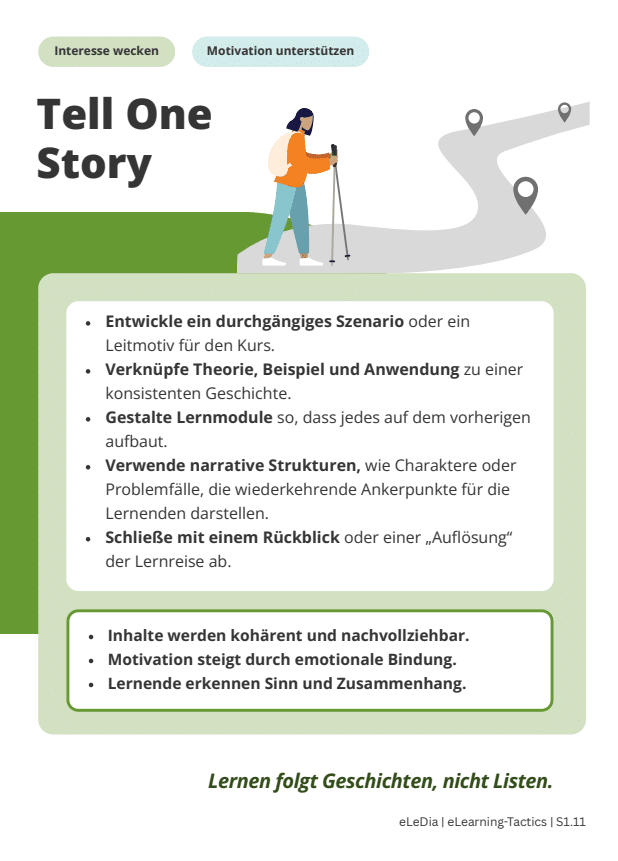
This is where Tell One Story comes in. The approach is based on the assumption that learning is particularly effective when content is embedded in a coherent narrative. A continuous narrative structure provides orientation, creates meaning, and helps learners to link new information in a meaningful way.
This is not about entertainment or dramatization, but about coherence. A "story" in the didactic sense describes a common thread: central questions, recurring motifs, and a comprehensible development throughout the entire learning process.
Theoretical reference
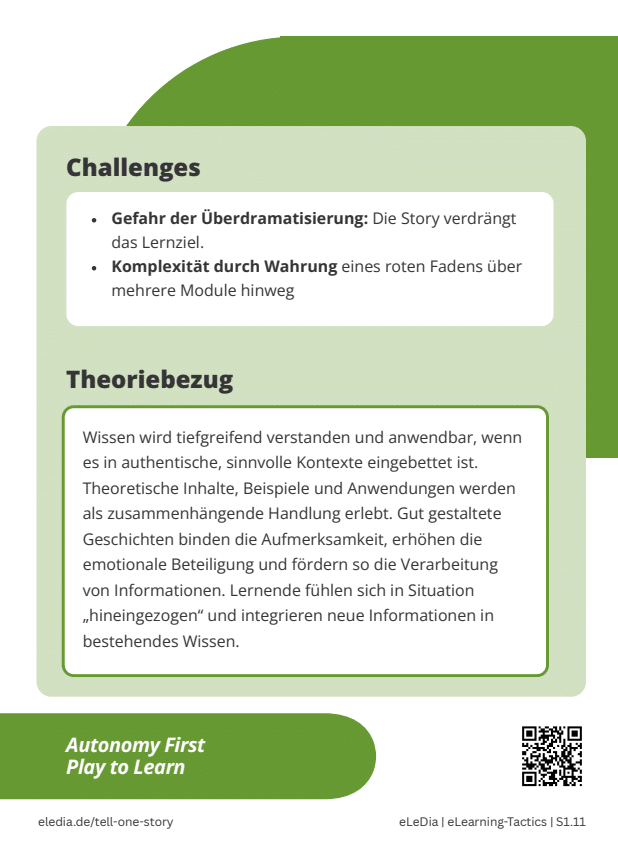
A theoretical basis for Tell One Story is the concept of anchored instruction. This approach was developed in learning and cognitive research to address precisely the problem that occurs in many digital learning offerings: knowledge is conveyed in a fragmented manner and therefore remains difficult to apply.
Anchored Instruction assumes that learning is particularly effective when new content is embedded in a shared, rich context , known as an anchor. This anchor is typically an ongoing story, an authentic problem, or a scenario that remains consistent across multiple learning phases. Individual pieces of content are not introduced in isolation, but are consistently linked back to this shared point of reference.
Empirical studies from educational psychology and cognitive science show that such anchors fulfill several functions that are effective for learning. They create coherence over time, facilitate the development of mental models, and support transfer because knowledge is anchored in an application context from the outset. As a result, learners develop an integrated understanding rather than loosely connected facts.
Another key feature of anchored instruction is that the anchor serves not only as an example, but also as a structuring element for the entire learning process. Learning tasks, discussions, and reflections repeatedly refer back to the same narrative or problem-oriented framework. Meaning is thus created not through explanation alone, but through repeated, contextualized engagement.
Recent reviews therefore classify anchored instruction as a precursor and conceptual basis for modern narrative, problem- and scenario-based learning approaches—especially in digital learning environments where coherence must be actively designed.
If coherence supports learning, digital learning offerings must do more than just provide well-designed individual modules. They need an overarching narrative logic that connects content and provides orientation over time.
Implementation in detail
The logic of anchored instruction results in a clear didactic sequence: anchor → tasks → reflection. The anchor forms a stable point of reference around which all further learning activities are organized.
- Set an anchor: At the beginning, a solid, content-rich anchor is introduced, such as an ongoing scenario, a case study, a project, or a story. This anchor remains present throughout several modules and serves as a common frame of reference.
- Align tasks with the anchor: Learning tasks relate explicitly to the anchor. New content is not introduced abstractly, but is understood as tools for better analyzing, solving, or further developing aspects of the anchor. Tasks vary in perspective and depth, but remain thematically anchored.
- Systematically incorporate reflection: Reflection phases reveal how understanding of the anchor has changed. Learners compare previous assumptions with new insights, draw conclusions for other contexts, and consolidate what they have learned.
This sequence ensures that learning does not proceed in a fragmented manner. The anchor creates coherence, tasks drive the examination of content forward, and reflection stabilizes understanding and transfer.
Practical example
A digital course on organizational development guides learners through the history of a fictional company. Each module highlights a new stage of development: from initial growth problems to restructuring and cultural changes. Technical concepts are explained and explored in depth in the context of this ongoing story.
Implementation in Moodle
Moodle supports narrative learning structures through:
- clear course overviews with introductory frameworks
- recurring case studies or scenarios
- explicit transition texts between sections
- media elements that pick up on the narrative framework
Conscious planning of the overall narrative is crucial.
Challenges
Narrative coherence requires conceptual work. Stories that are overly simplified can distort content, while narratives that are too complex can be overwhelming. Furthermore, the story must not become more important than the learning itself. Tell One Story therefore requires a careful balance between structure and technical expertise.
Conclusion
Tell One Story shows that learning is more than just stringing together content. Digital learning offerings that provide a coherent narrative framework facilitate understanding, promote retention, and create meaning beyond individual modules.
Bransford, J. D., Sherwood, R. D., Hasselbring, T. S., Kinzer, C. K., & Williams, S. M. (2012). Anchored Instruction: Why We Need It and How Technology Can Help. In Cognition, education, and multimedia (pp. 115-141). Routledge.
Lave, J., & Wenger, E. (1991). Situated learning: Legitimate peripheral participation. Cambridge University Press.
AI transparency notice: This text was created using generative AI based on extensive course notes. It has not yet been edited by human experts.
